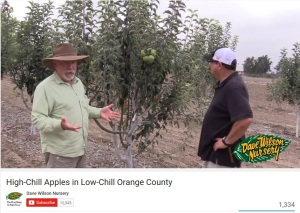
Tom Spellman from Dave Wilson Nursery held a pruning day at the high chill apple orchard in Orange County at UC Irvine’s South Coast Field Station, made famous by the YouTube video https://www.youtube.com/watch?v=oiEEHRfAEWY My wife and I were invited, along with about 15 Master Gardeners and members from the Orange County chapter of the California Rare Fruit Grower group.
This orchard has 30 varieties of apples listed between 800-1,000 hours of chill requirement, specifically:
Yellow Newtown Pippin
Bramley Seedling
Ashmead’s Kernel
Melrose
Belle de Boskoop
Waltana
Hudson’s Golden Gem
King of Tompkins County
Mutsu
Golden Russet
Arkansas Black
Gravenstein
Cox’s Orange Pippin
Sierra Beauty
Liberty
Jonagold
Akane
Honeycrisp
Snow
Golden Delicious
Empire
Zestar
Scarlet Sentinel
Red Fuji
North Pole
Braeburn
Tom had told me previously that he had a good fruit set despite lack of thinning, but we were all shocked at the size, quality, and quantity of apples still left on the trees, not to mention the pile on the ground under each tree. This orchard is 10 miles from the beach, next to the Orange County Great Park, the former El Toro MCAS, and surrounded by avocado groves on two sides. This research station is used mostly for testing semi tropic crops like dragon fruit, avocado, cherimoya, and persimmon, and is watered exclusively with reclaimed irrigation (much to the stress of the avocados). It gets at the most 200 chilling hours, and last winter was extremely warm. Once we got past the New Year’s Day freeze (8” of snow killing thousands of avocados in Temecula), we had weeks straight of temps in the 80s and 90s through February.
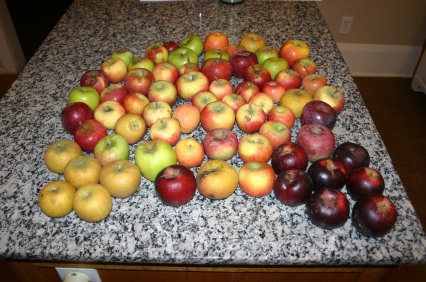
We had a lot of work to do and not much time, and so we started pruning immediately, grabbing what apples we could out of the branches and off the ground. Some were past their prime this being January and all, but Dixie Red Delight, Golden Russet, Red Fuji, Sierra Beauty, and Belle de Boskoop blew your head off. The hand’s-down favorite was Hudson’s Golden Gem, and exceptional flavor and crunch. By the end of the morning most of the pruning was done and we all ended up with bags of apples to take home.
There are two trees of each variety, and they didn’t get a lot of training while growing. An eastern transplant to the field station who had extensive apple experience at WSU had recommended to Tom that he convert the trees to tall spindle, which I concurred, and so he decided to convert over one of each of the two trees per variety, and the other one to remain an open vase shape as to preserve some production for next season. He also resolved to thin the fruit hard this spring for the best size.
The orchard could have easily supported a roadside stand, if it wasn’t situated in a highly developed area of Orange County on land probably worth hundreds of millions of dollars (2BR 1 BA single story homes start at $1 million). Being this close to the ocean, high temperatures are moderated to a max high of about 105F, but lows rarely get below 40F.
It was interesting to compare the apples here with the ones at my house farther inland in Riverside. Braeburn and Ashmead’s Kernel turn to mush in our heat, but in the moderate climate of Irvine they were both fantastic. I also have one tiny Arkansas Black tree that never produced, but the two trees of it in Irvine were loaded, showing that it isn’t the lack of chill that’s preventing mine from bearing. I supplied some of the scionwood to establish the orchard, and so it wasn’t a surprise to me that the trees were bearing, but I was surprised at the crop load so early in the M111’s lifetime. The farming conditions there are perfect; a deep sandy loam with good fertility, no pests or disease, no frost, and timed irrigation.
Tom had been discouraged by DWN staff and the Field Station management from trying this experiment, as all said it would result in embarrassing failure. I remarked that this is why most low-chill apple research is done by private individuals, who do not face ridicule or loss of funding if a trial doesn’t work out. I run into the same thing with Tropic universities, with much of the research done and risk taken by poor tropic farmers rather than academia or government organizations. The staff at the field station and the researcher from back East are bowled over by the results of the orchard.
I’m thankful to Tom for both the visit to the orchard, and also to the load of scionwood for our Uganda nursery he generously granted. DWN in general has been hugely supportive of the Africa nursery project, and I’ve freely shared the results of our low chill trials and recommendations for new varieties for their lineup.
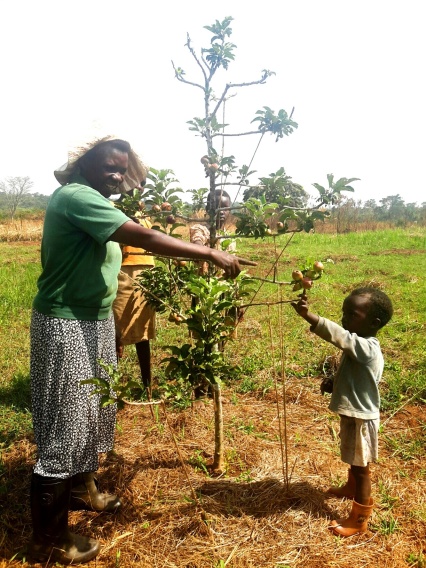 Fall of 2015 a sugar cane field next to our scionwood orchard at the Uganda nursery caught fire, and the fire spread to our mulch and killed the scionwood trees. These were the trees that were supposed to supply the cuttings that we graft new trees from.


 Apples and Oranges